Music as a biological functionin humans
Exploring the innate nature of music.
This presentation explores the innate presence of music from an evolutionary perspective, discussing its ancient, pivotal role in human life. Take a journey through deeply rooted biological reasons that tension and release in music affect you so deeply, and come to realise that you have always been a fluent musician - because you improvise with speech every day!
- Lecture-style talk
- Projected visuals
- Festivals and venues
Why is music everywhere?
Music is an incredibly widespread, ubiquitous phenomenon. In fact, there have been no recorded encounters with any culture, society, or group of people without music.
Why is music everywhere? Why is it so important to us? Why does it affect us in such powerful, transformative ways?
The focus of this talk: discovering the true depth of music’s innate nature. Showcasing how music is universal across all cultures and eras of our shared history.
This presentation will speak from an evolutionary standpoint, discussing how we have adaptively evolved music, why it has remained such a prominent aspect of life, how this greatly influences our social and sexual lives, and why the intrinsic nature of music means that EVERY ONE OF US can innately create music - in fact, we have ALL been musicians our entire life.
You are a master of an instrument already, even if you don’t realise.
The voice is a supremely versatile melodic, rhythmic, dynamic instrument. Every day, you fluently improvise with sound. The way it feels to ‘have a chat’ is the exact same way it feels to jam with high level musicians.
Topics covered
Musilanguage
How the early evolution of language actually began with music.
Baby-talk and infant-directed speech
How even as infants, we begin our learning of language through simple rhythm, melody and intonation.
Physical rhythmicality
Walking, breathing, and your heartbeat.
Socio-musical influences
And WHY you like the genres of music you like.
Tension and release
Build ups, drops, and the bizarre psychological mechanisms we all experience when listening to music.
Part 2: an experiential journey
Let’s listen to some CHUNES. Realtime tension and release. A journey back through our evolutionary pathway.
We all start very young
Before babies understand words, they are already listening to melody, rhythm, and timbre.
All over the world, we talk to babies in the same musical way: higher pitch, a wider range of pitch, hyper-articulated vowels, shorter phrases, more repetition and a gentler voice. Nobody teaches us this. Men, women and kids all do it, whatever the language.
Infant-directed speech suggests that the earliest layer of human communication is not just linguistic - it is musical.
And we sing to them too. Babies relax even to unfamiliar lullabies from other cultures, and it seems to work through melody, repetition, softness and tone, not the words alone.
Even sleeping newborns form expectations about the downbeat, and their brains notice when an expected beat goes missing.
From conception to embryo to baby, we are fed by the pulse at every moment. You were literally made by the doof!
Hilton et al., 2022; Bainbridge et al., 2020/2021; Winkler et al., 2009
Even sleeping newborns form expectations about the downbeat, and their brains notice when an expected beat goes missing.
Peacocking came from somewhere
Darwin reckoned musical notes and rhythm were first acquired “for the sake of charming the opposite sex”.
Across much of nature, the males are basically the original attention-seeking DJs. Male humpback whales write long-distance underwater love ballads, and are broadcasting subaquatic thirst over hundreds of kilometres.
- Songbirds and whales learn songs socially, not just instinctively.
- Humpback whale songs can spread across populations like cultural trends.
- Parrots can show beat-based movement to music, a rare trait outside humans.
- Animal parallels suggest that parts of musicality - rhythm, vocal learning, courtship, social transmission - have deep biological roots.
Humans are not outside this pattern. We just added lyrics, guitars, fashion, clubs, and subwoofers.
We’ve been doing this a long time
There are no known cultures without music, past or present.
The oldest musical instruments known are flutes made from bird bone and mammoth ivory, around 42,000 to 43,000 years old.
Music predates farming, cities, and writing by tens of thousands of years.
Group singing helps strangers bond faster than comparable non-singing group activities: the ice-breaker effect.
Genres do social work.
They help answer “Who are my people?” and “Who am I not?”
In every generation, the youth actively alter the music of their forebears and push its limits, in order to individuate themselves through their identity formation. A hundred years ago, jazz was the badboy music of the time.
When music builds tension and then resolves it, the brain’s reward system responds with dopamine, both during the build-up and at the drop.
Conard et al., 2009; Higham et al., 2012; Pearce et al., 2015; North & Hargreaves, 1999; Salimpoor et al., 2011
Satisfaction of curiosity
Why does music affect us SO MUCH? In my opinion, the level at which music affects us, is actually quite unreasonable.
Good music rides the balance between familiarity and novelty. Once a foundation of a song is set up, we need to continue to experience surprise, novelty, and satisfaction of curiosity at regular intervals - and yet the foundational bedrock of the music must stay familiar, engaging, and anchoring.
Whether we are experiencing fear, anticipation or surprise - these all result in natural human curiosity. If you hear a loud bang, you are physically obliged to turn around and check out what is going on. Your ancestors who were more likely to turn and respond to the curiosity, were more likely to survive and pass on their genes.
Music doesn’t just reward the payoff - it rewards the anticipation of the payoff.
We have all been musicians our entire life
This presentation is designed to both captivate and inspire you. You are born a natural creator, and music is an entirely natural, innate feature of consciousness.
A feature so ancient and ingrained that we each unconsciously engage with it daily - every time you speak, you are improvising through the musical medium of sound.
Come and experience some of the fascinating journey that has led us to this amazing place - being blessed in the modern day with a near infinite diversity of musical experiences right at hand - a wonder that our ancestors could never have predicted.
Who is this guy?
Drawing from years of professional experience and deep study as a jazz musician, John Sned has taken improvised music and brought it into alignment with the limitless possibilities of modern music production technology.
Since completing his Bachelor of Music at the Christchurch Jazz School in 2010, John has been performing as a multi-instrumental musician and electronic producer in numerous bands & projects across a great diversity of genres, in both New Zealand and Australia.
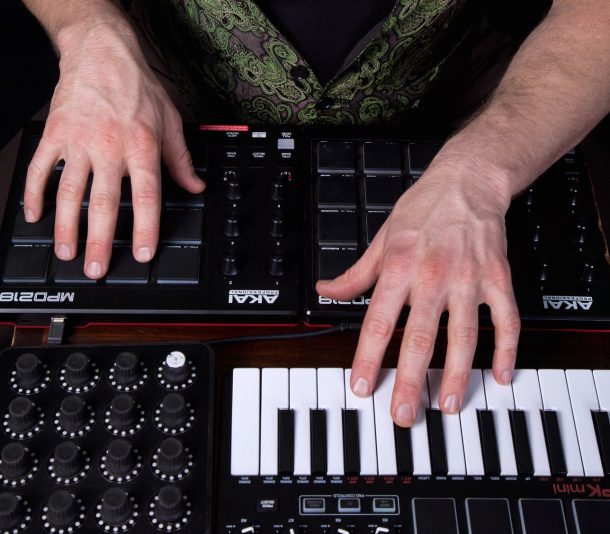
Growing up musically with one foot firmly in each world - years of dedicated musical study meeting years of electronic music immersion through festival culture - it only makes sense that the two worlds should meet. That live, improvised music should continue to make its way into the powerful world of the electronic. As an artist, John longs for more people - creators and listeners alike - to experience the exciting, unique possibilities afoot when these worlds combine. Investigate John’s live improvisational electronic fingerdrumming performances to explore these concepts deeper.
Currently based in Melbourne, John makes a living operating snedmusic.com as a professional educator with the design, hosting, and teaching of Ableton Live courses - facilitating the musical breakthroughs of keen musicians and producers, and inviting them into the world of electronic music production. John has previously tutored at Oxygen College in Geelong, where he helped build Australia’s first purely Ableton Live dedicated CertIV in Music Industry qualification.
Where this talk has featured previously
- Rainbow Serpent Festival
- Rainbow Spirit Festival
- Tanglewood Festival
- Dragon Dreaming Festival
- Twisted Frequency Festival
John also presents this work routinely in his in-person group Ableton Live music production courses.
Tech reqs, to enable full spectrum nerding / ranting capacity.
The venue provides:
- Projector, and a projection screen or suitable blank wall
- Microphone
- PA, with a mixer or PA input for computer audio (2 x 1/4-inch TRS, 2 x RCA, or DI if required)
- Small desk or table for the laptop and audio interface
- Power near the presentation area
John brings his own audio interface and cables. A short setup check before the talk confirms the projector, mic level, computer audio level, power and table position.
For smaller venues, John can bring his own setup.
Projector and screen, microphone and powered monitor speakers. Ask about this when you enquire.